
Across British Columbia the usual dividing line is 10 square metres, about 107 square feet. Below it most municipalities don’t ask for a building permit; at or above it they do. Zoning still applies either way, and each city sets its own numbers, so this page is the starting point rather than the final word. For a city-by-city example, see North Vancouver shed regulations.
How big can a shed be without a building permit in BC?
In British Columbia, the building code applies to a shed that is 10 square metres (about 107 sq/ft) or larger, or one that creates a hazard. Many cities follow this and don’t require a building permit for a smaller shed. Common sizes like 8′ x 10′ (80 sq/ft), 8′ x 12′ (96 sq/ft) and 10′ x 10′ (100 sq/ft) usually fit under the limit. A larger shed needs a building permit from the local municipality.
“No building permit” doesn’t mean “no rules.” Zoning bylaws still set where a shed can go, how tall it can be and how much of the lot it can cover. A shed used as an office or a place to sleep, or one with electrical or plumbing, can also need permits even when it’s small.
What cities say about sheds under 10 m²
- Whistler: if a shed is less than 10 m² and doesn’t create a hazard, a building permit may not be required. Zoning setbacks and height limits still apply.
- Kelowna: an accessory building under 10 m² doesn’t need a building permit but must meet the zoning setbacks and height limits.
- Penticton: a building of 10 m² or less doesn’t need a permit if it creates no hazard, but a building permit is required if it’s used for living or sleeping. Electrical work needs its own permit.
Rules outside BC differ. For example, some Ontario municipalities allow storage sheds up to 15 m² without a permit. Always check your own city’s rules.
How to find your municipality’s maximum shed size
Finding the limit for your own city is easy. Call your municipality’s building department and ask these three questions:
- “I’d like to build a shed in my backyard. What’s the maximum shed size without a permit?”
- “Do you measure that by the roof-print or the foot-print?”
- “Is there somewhere on your website I can download this information?”
Roof-print vs foot-print: same shed, two sizes

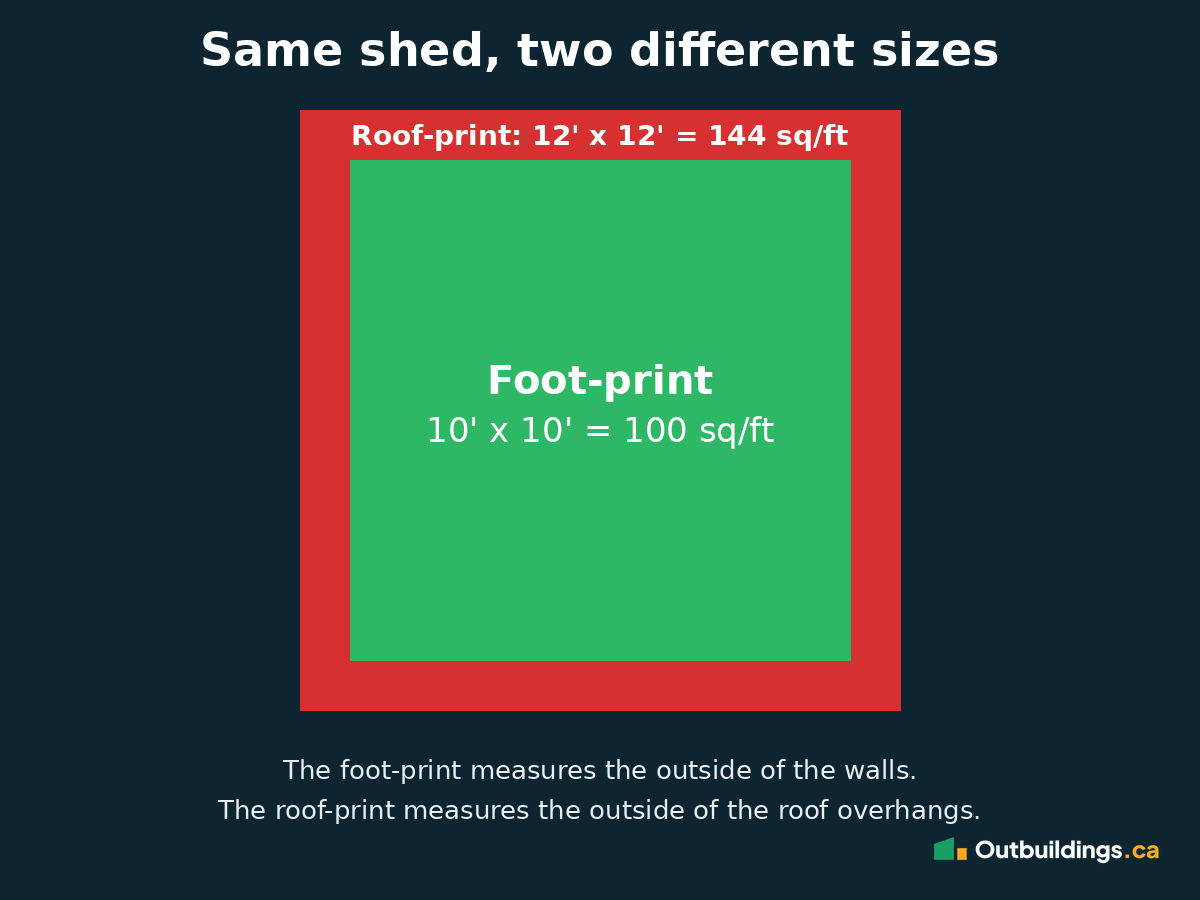
The roof-print versus foot-print question matters because each measurement gives a different size. The foot-print measures the outside corners of the walls and siding. The roof-print measures the outside corners of the roof overhangs.
In the diagram, the green foot-print is 10′ x 10′ = 100 sq/ft. The red roof-print is 12′ x 12′ = 144 sq/ft. It’s the same shed, but one measurement is under the 107 sq/ft limit and the other is over it. Find out how your municipality measures before you build, because the last thing you want is a shed that’s too large.
3 tips for dealing with your building department
- Always be polite. It seems simple, but you’d be amazed at how far it can get you.
- If you’re quoted a specific bylaw or zoning rule, ask for a paper copy for your records.
- When possible, deal with the same person for all your questions.
Metro Vancouver municipal websites
Start with your own city’s website:
- Vancouver
- North Vancouver District
- North Vancouver City
- West Vancouver
- Richmond
- Burnaby
- Coquitlam
- Port Coquitlam
- Port Moody
- Surrey
- Maple Ridge
- Pitt Meadows
- Langley
- Delta
- White Rock
Frequently asked questions
What is the maximum shed size without a permit in BC?
Most BC cities don’t require a building permit for a shed under 10 m² (about 107 sq/ft) that doesn’t create a hazard. Zoning rules still apply, and each city sets its own limits.
Is a shed measured by its roof or its walls?
It depends on the municipality. Some measure the foot-print (the walls) and some the roof-print (the roof overhangs), so ask your building department which one it uses.
Can I use a small shed as an office?
Often yes, but check first. Some cities require a building permit when a small building is used for living, sleeping or long working hours, and electrical work needs its own permit. See an example of a North Vancouver backyard office built without a building permit.
What the BC Building Code says
The 10 square metre line comes from the Code itself. BCBC 2024 Division A, sentence 1.1.1.1(2)(e) says the Code does not apply to accessory buildings of less than 10 m² in building area that do not create a hazard. Two things follow from that wording. “Hazard” is not defined, so the local building official decides what counts. And 10 m² is 107.6 square feet, which is why you see both 107 and 108 square feet quoted around the province: round down and you stay inside the limit.
The Code is only the floor. A municipality can be stricter, and the zoning bylaw, not the Code, is what sets your setbacks, height limit and lot coverage. Where a city’s own documents are silent or contradict each other, the provincial default above is what applies.
What isn’t confirmed
- Whether your municipality measures by roof-print or foot-print. This is the single question most likely to put a shed over the limit.
- What your building official treats as a “hazard”, which is a judgement call rather than a number.
- The setbacks, height limit and lot coverage for your own zone, which the zoning bylaw sets zone by zone.
- Whether a shed on a sloping lot, near a watercourse or in a protected tree area needs extra approvals.
For more, see the Saanich shed rules and North Vancouver shed regulations, or browse Backyard Outbuildings.