
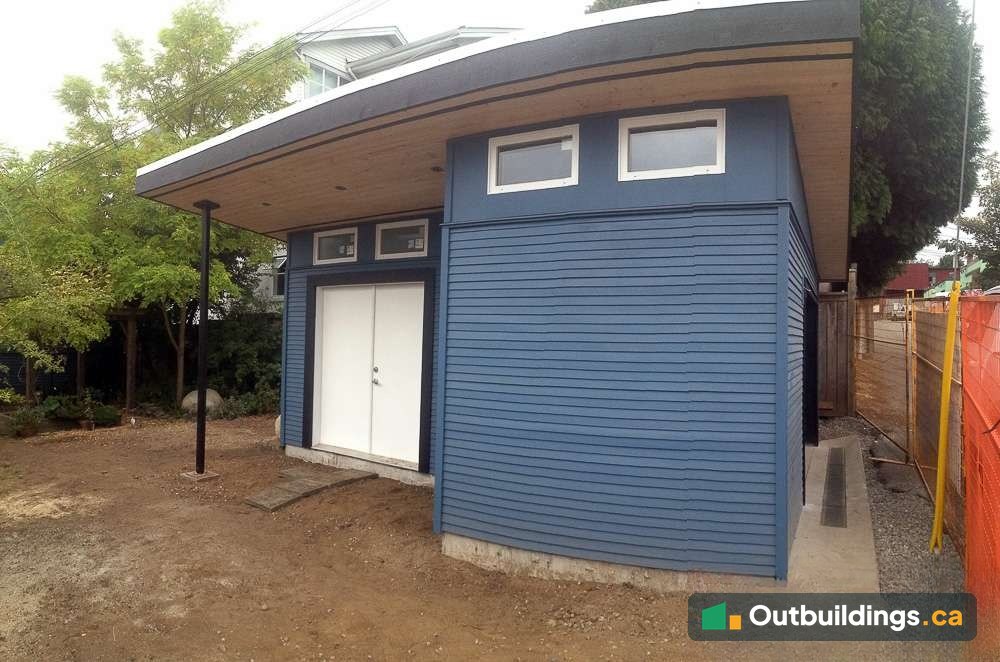
About this garage
This modern garage and flex space replaced a worn-out 1930s garage on a lane in East Vancouver. The new building has a 12×20 main space plus a 5×8 bike locker, and an 11×5 covered porch at the front. The old garage’s fir boards were saved and used again as siding, so the new building keeps a piece of the one it replaced. The photos follow the project from demolition to the finished garage.
A garage that does more than park a car
The main space is 12′ by 20′, big enough for a car, a workshop or a studio. A 5′ by 8′ bike locker sits at one end, and a covered porch shelters the entry. A 10′ roll-up door opens the front, and a 4′ roll-up door and a 60″ French door give more ways in and out.


Reclaimed fir from the old garage
When the old garage came down, its fir boards were saved. They were sorted, cleaned and cut to size, then went back on as siding. The weathered wood has a deep, warm colour that new lumber can’t match.


Before: the old garage
The old building was a 1930s garage with shingle walls. It had reached the end of its life, so it was replaced.


Site work and framing
After demolition, the crew dug out the footings, poured a slab and framed the walls. The walls and roof were sheathed, and the siding went on once the building was closed in.


| Location | East Vancouver, British Columbia |
|---|---|
| Size | 12′ x 20′ main space, plus a 5′ x 8′ bike locker |
| Porch | 11′ x 5′ covered porch |
| Siding | Reclaimed 1930s fir, blue lap siding and corrugated Galvalume |
| Roof | Standing seam, single-slope |
| Doors | 60″ French door, a 4′ roll-up door and a 10′ roll-up door |
| Windows | 3′ x 6′ slider plus a clerestory band |
| Power and heat | Yes |
More photos
The photos below show the walls, the roof framing and the siding going on.


What to plan before replacing an old garage
A lane garage works best when the old building, the new footings and the access are planned together.
- Salvage: old boards can be reused as siding. Plan the time to remove, clean and sort them.
- Access: lane sites are tight. Plan where materials go, and how the crew works around neighbours and wires.
- Doors: roll-up doors save space on a narrow lane and keep the opening clear.
- Power and heat: plan the electrical connection early, since the building will be used year-round.
- Permits and approvals: replacing a garage in Vancouver usually needs a permit. Check with the City.
Frequently asked questions
How big is the garage?
The main space is 12 feet by 20 feet. A 5′ x 8′ bike locker and an 11′ x 5′ covered porch are added to it.
What is the siding made of?
The siding combines reclaimed 1930s fir from the old garage, blue lap siding and corrugated Galvalume.
What doors does it have?
A 60″ French door, a 4′ roll-up door and a 10′ roll-up door.
Does it have power and heat?
Yes. The building has electrical power and heat.
Do you need a permit to replace a garage in Vancouver?
Usually yes. See the Shed Rules by City and Maximum Shed Size Without a Permit guides, then check with the City.
More outbuildings to explore
Browse more Backyard Outbuildings, read Maximum Shed Size Without a Permit, or check the Shed Rules by City.